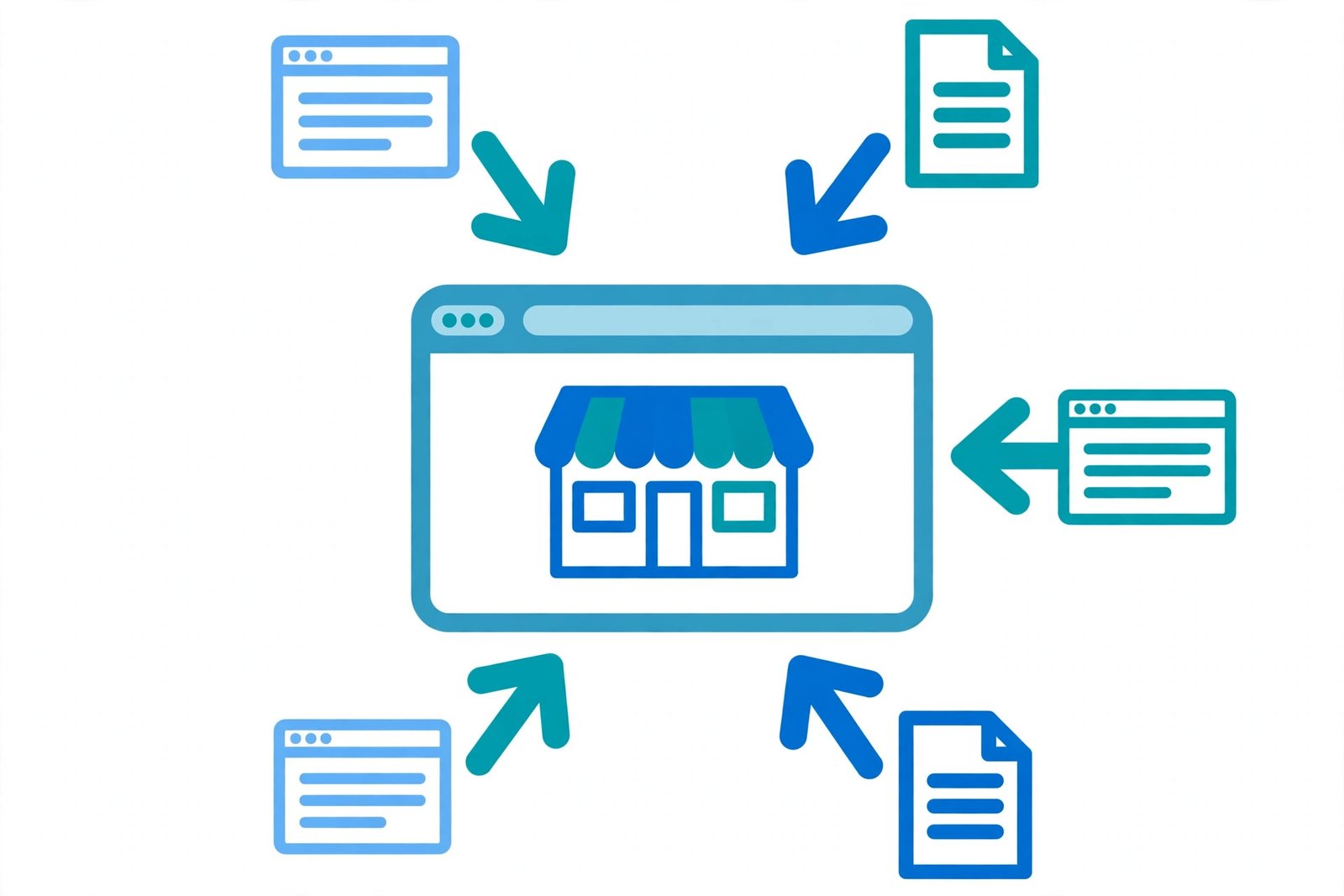
Quick answer: Off-page SEO is everything that happens away from your website to show search engines your business is trusted: links from other sites, mentions, reviews and business listings. On-page SEO is what you control on your own pages; off-page SEO is what the rest of the web says about you, and it is what builds authority over time.
Think of your website as a small shop. On-page SEO is the shop itself: the sign, the shelves, the prices, the opening hours. Off-page SEO is what people say about the shop when you are not in the room: a neighbour recommends it, a local paper mentions it, a customer leaves a five star review. Search engines listen to both, and for a small business the second voice is often the one that decides whether you rank or stay invisible.
This guide explains off-page SEO in plain English, shows you the signals that matter, gives you a week by week plan that uses free tools only, and tells you what not to do under Google spam rules. It is the strategy companion to our tactics guide, How to Build Backlinks for a New Website, which covers the step by step tactics in detail.
What is off-page SEO?
Off-page SEO, also called off-site SEO, is all the work done outside your own website to improve how it ranks. The biggest part is earning links from other websites, but it also covers brand mentions, customer reviews, business listings and local media coverage. If on-page SEO is what your site says about you, off-page SEO is what the rest of the web says about you.
Search engines need these outside signals because anyone can write good things about their own business. A link or a mention from an independent site is harder to fake, so Google treats it as a vote of confidence. One link from a real, relevant website that people actually visit is worth far more than dozens of links from sites nobody reads.
For a small business, off-page SEO is mostly local and practical. It is your Google Business Profile, your reviews, your listings in the places customers actually look, and a handful of genuine links from suppliers, local organisations and industry sites. You do not need a big budget or a PR agency. You need consistency and a little patience.
Why does off-page SEO matter for a small business?
It matters for three reasons, and each one is easy to check against what Google itself publishes.
First, links are how Google finds your pages. Google SEO Starter Guide says it primarily finds pages through links from pages it has already crawled. A new page with no links pointing to it is hard for Google to discover at all, and a whole site with no links is starting from zero.
Second, links are still a ranking input. Google guide to ranking systems says PageRank, its link analysis system, is still part of its core ranking systems. Links are not the only factor, and they are not a shortcut, but a site with genuine links from relevant sites has an advantage a site with none does not.
Third, the gap between sites with links and sites without them is large. In a study dated December 2023, Ahrefs reported that 96.55 percent of the roughly 14 billion pages in its index received no traffic from Google, and that pages with no referring domains almost never earned meaningful search visits. The lesson for a small business is not that you need thousands of links. It is that a site with none is starting the race on the sidelines.
There is also a local reason. Google guide to local ranking on Business Profile names three factors: relevance, distance and prominence. Prominence is about how well known a business is, and it includes how many websites link to the business and how many reviews it has. For a local business, off-page work is what builds prominence.
What are the main off-page SEO signals?
Off-page SEO is not one thing. It is a small set of signals, and each one tells Google something different about your business. This table covers the five that matter for a small business.
| Signal | What it looks like | What it tells Google |
|---|---|---|
| Backlinks | Another website links to one of your pages | Your content is trusted and worth ranking |
| Brand mentions | Another site names your business, with or without a link | Your business is real and talked about |
| Reviews | Customers rate and review you on Google and elsewhere | Customers trust you, which feeds local prominence |
| Business listings | Your name, address and phone number listed consistently | Your business exists and serves a real place |
| Social and community activity | People share your content and talk about you online | Your content reaches real people who may link to it |
A note on social media: sharing does not pass ranking value the way a link does. Its value is indirect. It puts your content in front of the people who can link to it, mention it or review you. Treat social activity as distribution for your off-page work, not as the work itself.
Before you start any of this, fix your own pages first. Off-page work sends trust to your site, and that trust is wasted if the pages it lands on are thin, slow or confusing. Run through our On-Page SEO Checklist for Beginners first, and check the technical basics with our technical SEO audit guide. Then build outward.
On-page vs off-page SEO: what is the difference?
People mix these two up, so here is the short version. On-page SEO is everything you change on your own website. Off-page SEO is everything that happens about your website somewhere else. You control the first directly. You can only earn the second.
| On-page SEO | Off-page SEO | |
|---|---|---|
| Where it happens | On your own website | On other websites |
| Who controls it | You, directly | Other sites and people, earned by you |
| Examples | Titles, headings, content, internal links, page speed | Backlinks, mentions, reviews, listings |
| What it proves | Your pages are relevant and well built | Your business is trusted by others |
| Time to see results | Days to weeks | Weeks to months |
Neither works alone. A well built page with no outside trust struggles to rank, and a trusted site with poor pages wastes the trust it earns. Fix on-page first, then build off-page steadily. That order is the whole strategy in one sentence.
How do you start off-page SEO? A week-by-week plan
You do not need paid tools to start. Everything in this plan uses free tools: Google Search Console, Google Business Profile and Google Alerts. The plan runs over nine weeks, then settles into a steady rhythm. It is a strategy plan. The detailed tactics for each step, including broken link building, journalist outreach and guest posting, are in our backlinks guide for new websites.
| When | Focus | What to do | Free tool |
|---|---|---|---|
| Weeks 1 to 2 | Foundations | Claim and complete your Google Business Profile, list your business in the directories your customers use, and make your name, address and phone number identical everywhere | Google Business Profile |
| Weeks 3 to 4 | Reviews | Ask happy customers for a Google review, reply to every review you receive, and add fresh photos and posts to your profile | Google Business Profile |
| Weeks 5 to 8 | Content worth linking to | Publish one genuinely useful guide or free resource, then tell the right people about it: suppliers, local organisations and sites that already link to similar guides | Google Search Console |
| Week 9 onwards | Steady rhythm | One useful piece a month, keep listings accurate, keep asking for reviews, and check your links monthly | Search Console Links report |
Two details make the difference between a plan that works and one that wastes your time. First, consistency of your business details matters: if your name, address or phone number differs between listings, Google has a harder time trusting that they describe the same business. Second, relevance beats volume at every step. One link from a supplier, a trade body or a local organisation in your area is worth more than ten links from unrelated directories.
If you want the traffic side of this plan, read how to get organic traffic to a website fast and free. It covers the free channels that feed the same goal.
What should you not do?
Google spam policies are clear about what counts as link spam, and the list is worth knowing before you spend money or time on the wrong thing.
Do not buy links. Do not join link schemes or excessive link exchanges where sites link to each other only to manipulate rankings. Do not use automated link building tools. Do not add your site to every low quality directory you can find. And do not stuff exact match keywords into the links in guest posts or forum signatures: Google spam policies specifically name links with optimised anchor text placed in guest posts, articles or forum signatures as link spam.
Paid or sponsored links are a separate case. They are allowed, but only when they are marked with rel=”sponsored” or rel=”nofollow” so search engines know not to count them as votes. An unmarked paid link is link spam, and it puts the site that paid and the site that sold it at risk.
The risk is real. Google can simply ignore spammy links, which means the money and time are wasted, or it can take manual action against a site, which is far worse. For a small business, the safe rule is simple: if a link would embarrass you if a customer saw how you got it, do not get it that way.
How do you know off-page SEO is working?
Check four things, once a month, all free. In Google Search Console, open the Links report and watch the number of sites linking to you and which of your pages they link to. Watch the total number of referring domains, not the raw number of links: ten links from one site count far less than ten links from ten sites. Watch your impressions in Search Console for the pages you are building links to. And if you are local, watch your Google Business Profile for calls, direction requests and new reviews.
Be patient about timing. Most honest guides put the wait at three to six months before off-page work shows measurable movement in rankings or traffic. That is normal. Links take time to be found, and trust builds slowly. If after six months your referring domains are still at zero, the plan is not working and something in the foundations needs fixing, usually the content itself. Links follow content worth linking to, so a page nobody links to is usually a page that needs to be more useful first.
Frequently Asked Questions
What is off-page SEO in simple words?
Off-page SEO is what the rest of the web says about your business: links from other sites, mentions, reviews and business listings. On-page SEO is what your own site says about you. Search engines use both to decide whether to trust and rank you.
Is off-page SEO just link building?
No. Link building is the biggest part, but off-page SEO also covers brand mentions, customer reviews, business listings and local media coverage. A site with links but no reviews and inconsistent listings is missing most of the picture, especially for a local business.
How long does off-page SEO take?
Plan on three to six months before you see measurable movement in rankings or traffic. Foundations such as your Business Profile and listings can show results sooner, but links and authority build slowly. Anyone promising results in days is selling something Google warns against.
Can a small business do off-page SEO for free?
Yes. The whole plan in this guide uses free tools: Google Search Console, Google Business Profile and Google Alerts. What it costs is time: a few hours a week for the first two months, then a steady hour or two a month to keep it going.
Do I need off-page SEO if my on-page SEO is good?
Yes. Good on-page SEO proves your pages are relevant and well built, but it does not prove anyone else trusts you. Google still uses links and other outside signals as a core part of its ranking systems. Fix on-page first, then build off-page. Neither works alone.
Are paid links allowed?
Paid links are allowed only when they are marked with rel=”sponsored” or rel=”nofollow”. An unmarked paid link counts as link spam under Google policies. For most small businesses, earning links with useful content and genuine outreach is cheaper and safer than paying for them.
Start with trust, not tricks
Off-page SEO is slow, unglamorous work: a complete Business Profile, consistent listings, honest reviews and a few genuine links from sites that matter in your world. That is the whole secret. Do the foundations in the first month, publish one thing worth linking to, tell the right people about it, and repeat. The tactics for the outreach itself are in our backlinks guide for new websites, and the on-page half of the job is in our on-page SEO checklist. Together, they are the plan. Now start week one.